
Roland-Garros 2026: Ticket Prices Takeaways
€175 or €300, same demand. The cost of underpricing, seen at Roland-Garros finals.

Summarize article with AI


In the final days before the 2025 Roland-Garros finals, last-minute tickets on the resale market were going for as low as €175. A discount, sure. Official face value for the men's final on Philippe-Chatrier started at €220 that year, so €175 looked like a deal worth grabbing.
But the deal wasn't really the deal. Demand at €300 was practically identical to demand at €175. Same buyer interest. €125 higher price.
That's the cost of underpricing, and it's hiding in plain sight at one of the biggest sporting events of the year.
What we actually measured
We ran a Price Discovery study on Priceagent in the lead-up to the finals, sampling real consumers who were actively looking for or had already bought French Open / Roland-Garros tickets. The study captured willingness to pay across the entire interested market, then sliced it by ticket type, court conditions, tournament stage, men's vs women's draw, and favorite player.
The headline number from the entire market view:
- Intended price: €250
- Maximize demand price: €119 (78.95% of the sampled market would buy)
- Maximize revenue price: €299 (54.89% demand, revenue score 100/100)
- Premium price ceiling: €499 (30.83% demand)

What the data shows clearly: the demand curve doesn't drop the way intuition says it should. From €120 to €200, demand barely moves (78.95% to 71.43%). It then holds in the 60% range all the way through €250. The first real cliff doesn't appear until just past €300.
In other words, buyers in this market are far less price-sensitive in the €175 to €300 band than the resale market behavior would suggest. The Priceagent platform's AI-powered interpretation called it directly: "EUR 250 is a strong bridge into premium pricing... only 6 points below the peak revenue score at EUR 299, so it is a practical monetization point for customers who are not ready for the top tier."
The story under the average
Averages flatten everything interesting. The real value of running this study wasn't the €299 revenue-maximizing price for the whole market. It was what happened when we segmented the audience.
Ticket type: where the premium buyers actually live
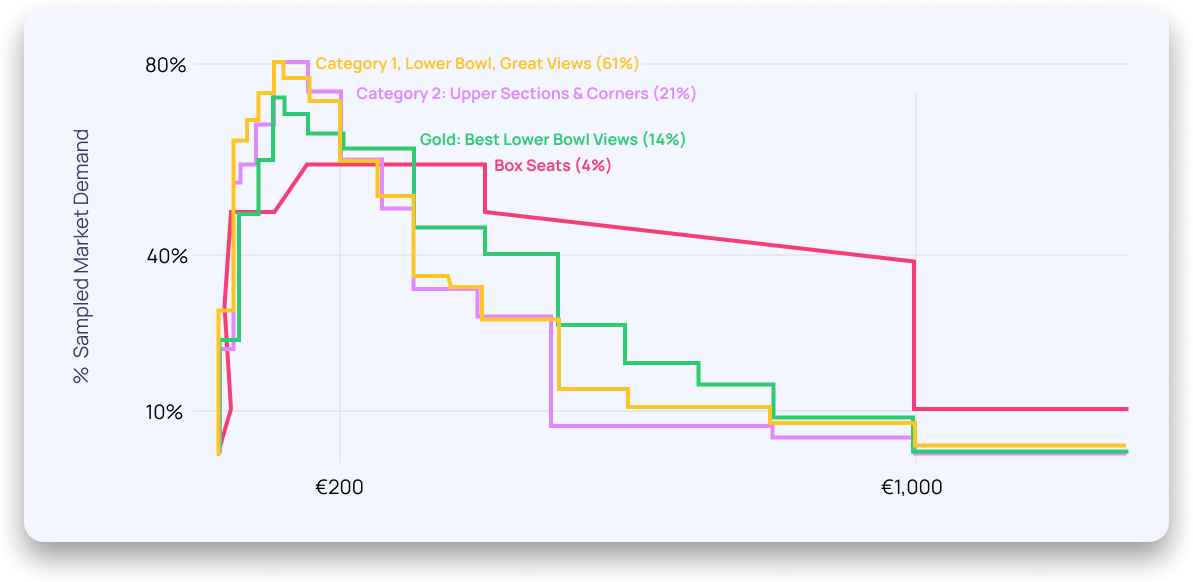
Four ticket categories surfaced from the buyer pool:
- Lower bowl, great views: 61%
- Upper sections and corners: 21%
- Gold (best lower bowl views): 14%
- Box Seats (Premium VIP): 4%
The Box Seats segment is small, but the willingness-to-pay ceiling tells a different story than the entire-market view. For Premium VIP buyers, the maximum revenue price jumps to €999. That's a 234% lift on the entire-market max revenue price of €299, found in just 4% of the audience. The pricing wall for this segment doesn't even start collapsing until well past €1,000.
This is the kind of pocket that gets missed when you set one price for everyone, or when you anchor against last year's averages.
Sun or shade: a small detail with a big WTP signal
68% of buyers prefer shaded seating. For that segment, the max-revenue price climbs from €299 (entire market) to €499, with 34.12% demand still intact at that price point. A +€249 per-ticket lift on the maximize-revenue setting, simply by isolating the seat-condition preference.
The Sun segment behaves differently: comparable demand at lower prices, but the curve drops faster at the top end. Same product. Different buyers. Different ceilings.
Tournament stage: not all rounds are created equal
The split by tournament stage:
- Quarter-Finals: 37%
- Semi-Finals: 33%
- Final: 16%
- Round of 128: 14%
The Final segment is smaller than you'd expect (16%), but its revenue score at €250 hits 86.42/100, which is one of the strongest revenue scores at the intended price across any segment in the study. Quarter-Finals fans cluster more around the lower-mid range. The implication is straightforward: applying the same ticket price across rounds leaves the most revenue on the table during the Finals, not the early rounds.
Men's vs Women's draw
82% of the buyer pool was primarily interested in the Men's tournament; 18% in the Women's. For the Men's segment, max demand sits at €119 and max revenue at €299, very close to the entire-market shape. The Women's segment is smaller, so the pricing implication isn't about extracting more from those buyers. It's about not treating the two audiences as one and the same when designing communications and packages.
Favorite player: where fandom becomes pricing power
This was the most interesting segmentation slice in the study.
- Carlos Alcaraz: 40%
- Arthur Fils: 22%
- Jannik Sinner: 20%
- Aryna Sabalenka: 11%
- Coco Gauff: 4%
- Iga Świątek: 3%
Alcaraz fans alone account for 40% of the buyer market. When we isolated that segment, the max-revenue price moved from €299 to €499, a 100% lift on max revenue (+€249 per ticket) with 36.54% demand still intact. That's a willingness-to-pay signal you can act on: dynamic packaging around marquee players, marketing copy targeting their fan base, premium offers tied to their match days.
Backward-looking sales data can't tell you which segments would have paid more. Forward-looking willingness-to-pay data can.
What this means beyond tennis
Last-minute resale pricing reacts to inventory pressure, not to demand structure. €175 looked like the right discount because someone needed to clear seats before the gates opened. The buyers were never the problem. The price was.
Most businesses don't lose revenue because of weak demand. They lose it because they underestimate what customers are willing to pay, and they only ever see the half of the story their historical sales data captures.
A few things to take away from this study, whether you sell tickets or anything else:
- The average price is a trap. The entire-market max-revenue price for Roland-Garros sat at €299. Segmenting by ticket type pushed the ceiling to €999. Segmenting by player loyalty pushed it to €499 across a much larger audience.
- Demand curves rarely drop where you think they do. Between €119 and €250, demand barely moves. Most pricing decisions get made in this band, and most of them are too cautious.
- The €125 question scales. What if you charged €125 more per unit on the seats, subscriptions, or product variants where buyer willingness already exists? That number compounds quickly.
Knowing how much your customers will pay is the difference between protecting margin and giving it away.
Explore the Results Yourself