Glossary
Willingness to Pay (WTP)
WTP is the foundation of value-based pricing. It captures the dollar value a buyer assigns to an offering, given the alternatives available and the value they expect to receive. Unlike a list price set by the seller, WTP lives in the buyer's mind — and shifts with context, framing, segment, and the specific configuration being considered. It's rarely a single number; the same buyer typically has a range across four thresholds (too low, bargain, stretch, too high).
Predictive Demand Engine (PDE)
Priceagent's proprietary algorithm for transforming individual willingness-to-pay responses into a continuous, high-resolution demand and revenue curve.
Plots buyers remaining at each price point as price changes.
In its classical form, the curve begins up and then slopes downward: as price rises, demand falls. But real demand curves are rarely smooth lines. They contain steep drops where buyers abandon a price (psychological barriers) and flat sections where increases barely affect demand. The shape is where pricing strategy lives — answering questions a list price cannot, like how much volume you lose by raising the price $5, or where small changes create disproportionate effects.
What the curve makes visible. Priceagent's PDE constructs the demand curve from real buyers' WTP ranges, with each respondent contributing a continuous range rather than a single point. The result is a curve detailed enough to identify exact inflection points — including Price Walls and Price Plateaus — that flat sample-size methods miss. It's plotted alongside the Revenue Curve so volume and turnover are visible together.

Plots projected total turnover at each price point, calculated as price multiplied by predicted demand at that price.
The revenue curve answers a question the demand curve cannot: at what price does the business actually make the most money? A lower price captures more buyers but earns less per unit; a higher price earns more per unit but loses buyers. Somewhere between is the price that yields the highest total revenue — and it's rarely the price that maximizes volume.
Replacing the volume-vs-margin trade-off. The revenue curve is a direct output of the PDE. Once the demand curve is built from respondents' WTP ranges, the engine multiplies each price point by its predicted demand to produce the projected revenue at that coordinate. The result is plotted on the same chart as the demand curve, with the Maximum Revenue Price and Maximum Demand Price called out automatically.

Value-Based Pricing
Pricing strategy in which the price is set based on the value the product delivers to the customer, rather than on the cost to produce it or the price competitors charge.
Value-based pricing flips the question. Cost-plus pricing asks "what does this cost us to make?" Competitor-based pricing asks "what is everyone else charging?" Value-based pricing asks "what is this worth to the buyer, and what share of that value can we capture?" In practice, it requires two inputs: a clear understanding of which features and benefits drive value for which buyers, and a measurement of what those buyers would actually pay.
What value-based pricing depends on. Priceagent provides both inputs. The platform measures Willingness to Pay directly, segmented by buyer profile and value driver, so businesses can see which features move the demand curve and by how much. The output is a defensible value-based price grounded in real buyers' WTP — not a markup, not a competitor benchmark.
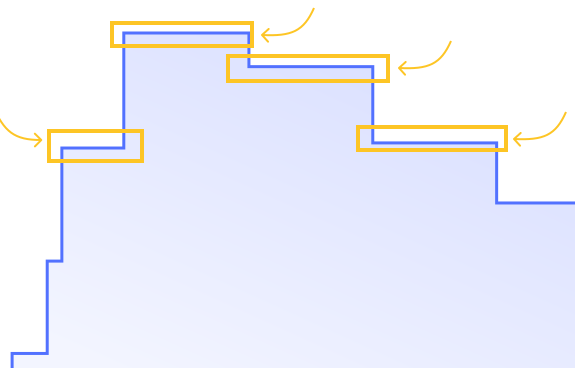
Specific price point at which a small increase causes a disproportionately large drop in demand — typically 5–10% or more for a minor price change.
Price Walls are psychological. They tend to cluster around round numbers, threshold prices buyers carry in their heads ("under $50", "less than $100"), and category reference prices established by competitors. Crossing a Price Wall, the vertical drops in the demand curve, means losing a meaningful share of buyers who would have bought one or two dollars lower (or higher!). They're one of the most consequential feature of a real demand curve, and the feature that traditional methods are least equipped to detect. Target the edge. The pricing best practice is to set the price at the highest point immediately before a Price Wall, capturing the maximum margin from buyers above without losing those below. Priceagent's PDE plots demand at every unique price point and flags significant step-drops automatically.

A range of prices over which an increase has little to no impact on demand, an underpriced zone where margin can be captured without losing buyers.
If a Price Wall is a cliff, a Price Plateau is a flat stretch of road. Within a Plateau, a $5 or $10 increase moves through the same pool of willing buyers without losing any of them. Plateaus exist because buyer perception isn't perfectly granular — between two psychological reference points, small changes don't cross any threshold worth noticing.
Avoid the center. The pricing best practice is to never sit in the middle of a Plateau — the optimal price within any flat range is at the top, immediately before the next Price Wall. This is how Priceagent users typically capture the 15% revenue increase potential without sacrificing volume.
Priceagent's deep, comprehensive pricing study type, designed to map the full demand and revenue landscape, segment buyers, and uncover the value drivers behind willingness to pay.
A Price Discovery study runs the full PDE methodology with Segmentation Analysis and demographic filtering, so businesses see not just one demand curve but how the curve shifts across audience segments, value drivers, channels, and competitive positions. It captures more than the optimal price — it surfaces which features drive the highest WTP, where premium positioning is supportable, and how demand changes across geographies.
When the question is bigger than the price: Price Discovery is the format used when the pricing question goes beyond "what should we charge?" to "why does the demand curve look the way it does, and which segments and features should we build the strategy around?" Available on Professional and Enterprise plans.

Priceagent's fast, streamlined pricing study type — designed for day-to-day pricing decisions, quick validations, and rapid A/B-style comparisons.
A Price Check captures the topline demand and revenue curves for a product in under an hour, using the same PDE methodology as a Price Discovery but with a simplified survey scope. It returns the same core outputs — demand curve, revenue curve, Price Walls, Price Plateaus, MRP, MDP, Floor Price — without the segmentation depth that distinguishes Price Discovery.
Pricing as a routine, not a project. Price Check makes pricing intelligence a routine operating practice rather than an annual exercise. When the cost of a quick study drops to a few hours and a small respondent panel, businesses validate pricing decisions continuously instead of relying on intuition between major reviews. Available on every plan from Starter upward.

Forward-Looking Pricing Data
Information about how buyers will respond to prices in the future — captured by measuring willingness to pay among real prospects — as opposed to backward-looking data, which describes how buyers responded to prices in the past. Most pricing inputs are backward-looking. Point-of-sale data, historical sales records, and competitor pricing all describe what has already happened — useful for measuring the past but limited for predicting the future, particularly when products are new, markets are shifting, or competitive dynamics are changing.
What the past can't tell you; Priceagent measures forward-looking willingness to pay among validated buyers using the PDE. Studies run in hours rather than weeks, which means forward-looking data can be refreshed continuously rather than collected once a year. Markets move, customer preferences change, willingness to pay shifts — and the platform is built to track all three in near real time.