
How Do Tech Giants Know How Much They Can Raise Prices?
Apple raised the MacBook Pro $300 overnight. Our data shows why it works.
Summarize article with AI


Apple raised the base MacBook Pro from $1,699 to $1,999 overnight. Same machine, no upgrades. We ran a Price Check on the new price, and the data explains exactly why Apple could do it.
KEY FINDING
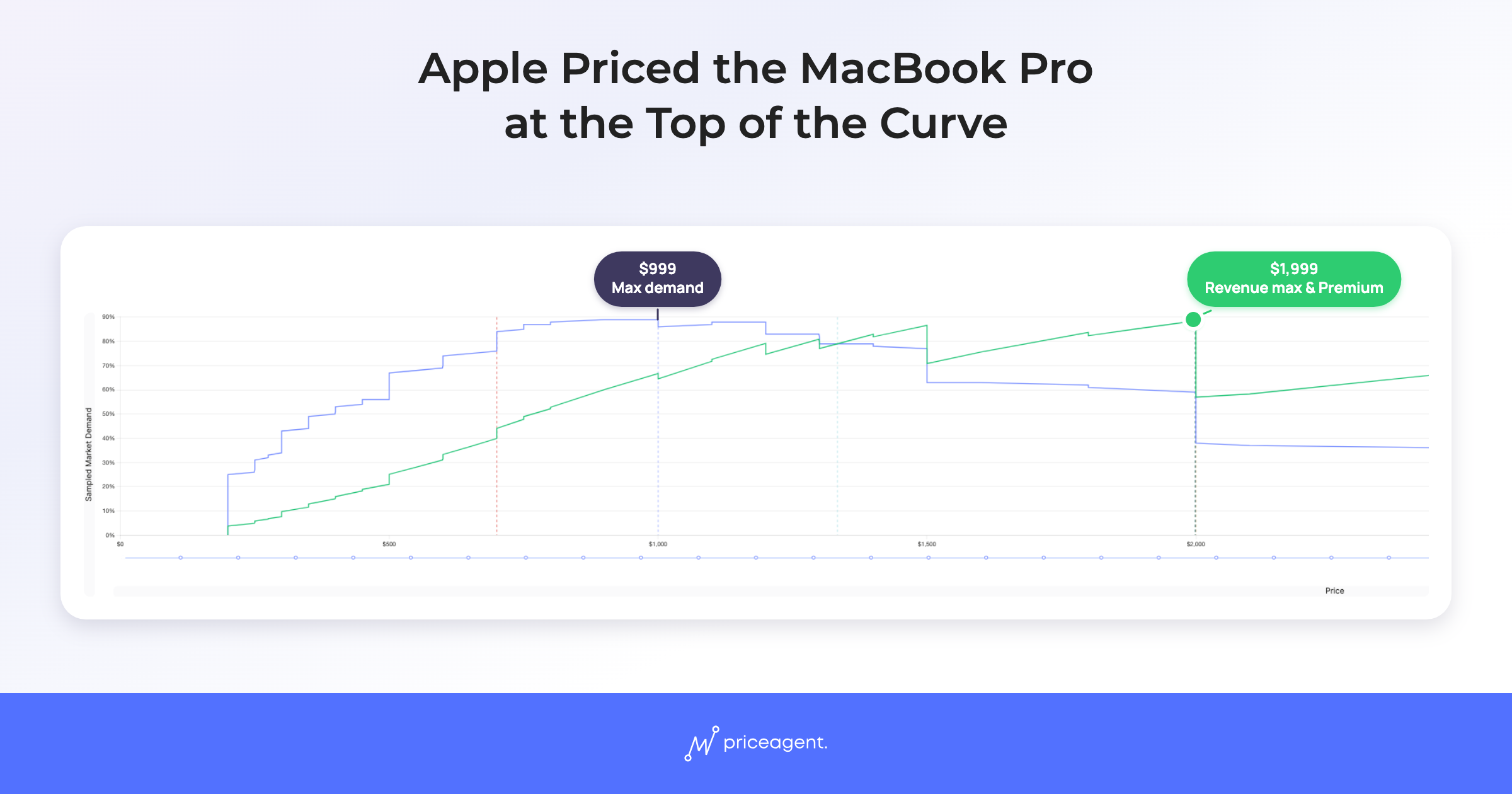
Apple priced at the exact top of its revenue curve. A Priceagent Price Check found demand peaks at $999, yet $1,999 is the revenue-maximizing price. Apple traded more than 30 points of demand for maximum revenue, and the willingness-to-pay data says the trade works.
The short answer
Tech giants know how much they can raise prices because they measure willingness to pay before they move. They quantify the price where demand peaks, the price where revenue peaks, and the gap between the two. Apple's jump to $1,999 looks bold, but willingness-to-pay data shows it lands exactly on the revenue-maximizing price.
A $300 price raise, overnight, on the same product
On June 25, 2026, the base MacBook Pro that cost $1,699 on Monday cost $1,999 on Thursday. Apple did not launch a faster or better machine. It repriced the exact same one, citing memory chip costs that have surged as AI data centers consume the world's DRAM supply, with prices up as much as 98 percent in the first quarter of 2026.
The market flinched. Apple stock fell more than 6 percent, its worst single day in over a year, and analysts openly questioned whether customers would accept the new price. That question, whether a market will bear a higher price, is usually treated as unknowable until the sales numbers come in months later.
But that question is measurable before the sales numbers arrive, so we measured it.
We tested Apple's new price against real willingness to pay
How the study was created
- Method. A Priceagent Price Check using the Predictive Demand Engine, testing the $1,999 price point against a sampled market of potential laptop buyers.
- Fieldwork. June 20 to July 5, 2026.
- Output. Demand curve and revenue curve across a $0 to $4,500 price range, plus six key price points.
Intended price
$1,999
The price tested, matching Apple's new base MacBook Pro price
Floor price
$699
The lowest acceptable price before buyers doubt quality
Max-demand price
$999
The price that attracts the largest possible audience
Safe-zone price
$1,329
The price that balances demand and revenue
Revenue-maximizing price
$1,999
The price that delivers the highest total sales revenue
Premium price
$1,999
The highest acceptable price before demand collapses
$699Floor
$999Max demand
$1,329Safe zone
$1,999Revenue max · Premium · Apple's price
What Apple is trading, in numbers
The demand curve tells a clear story. Demand peaks around the max-demand price of $999, where the largest share of the sampled market is willing to buy. At $1,999, demand is more than 30 percentage points lower. Apple's new price walks away from over a third of its potential audience.
The revenue curve tells the other half. Because every remaining buyer pays $1,000 more than they would at the max-demand price, projected revenue keeps climbing all the way up the range and peaks at $1,999. Apple is charging double the max-demand price while keeping almost two-thirds of the market, and the willingness-to-pay data says the trade works.
$999
Where demand peaks. The market-share price.
$1,999
Where revenue peaks. Exactly where Apple priced.
2x
Apple charges double the max-demand price and keeps nearly two-thirds of buyers.
There is one more finding, and it is the sharpest one. In this study, the revenue-maximizing price and the premium price are the same number: $1,999. The premium price is the highest acceptable price, the ceiling of the range buyers will tolerate. Apple did not just raise its price toward the top of the curve. It priced at the top of the curve. The move is validated, and it also means the headroom above it is gone. If component costs keep climbing, the next $300 cannot simply be passed on.
Apple's price raise was not a bet. It was a reading of a curve most companies have never seen for their own products.
So how do tech giants actually know?
They treat willingness to pay as a number to be measured, not a mystery to be debated. A company like Apple invests heavily in pricing research, conjoint analysis, and demand modeling before it moves a single price. That research answers three questions: at what price does demand peak, at what price does revenue peak, and how much demand do we lose between the two. When the answer to the second question matches the price you need to cover rising costs, you move overnight and absorb a rough day in the stock market, because you know the revenue holds.
The uncomfortable part is that most companies facing the same cost pressure right now, from memory chips, tariffs, and inflation, are making the same size decision with none of that visibility. They raise prices by a percentage that feels safe, then wait a quarter to find out what it did to demand. The tech giants' advantage is not courage. It is information.
What this means if you are not Apple
The logic Apple used is not exclusive to trillion-dollar companies. Any product has a floor price, a max-demand price, a safe zone, and a revenue-maximizing price. A Price Check on the Priceagent Platform measures them directly from your market: real potential buyers, modeled by the Predictive Demand Engine into the same demand and revenue curves this case study is built on.
If your costs are rising and you are deciding how much of that to pass on, the question is not whether your customers will tolerate a price raise. The question is which price point you are moving to, and whether it sits in your safe zone, at your revenue maximum, or past your premium ceiling. Those are three very different outcomes, and the difference between them is measurable before you commit.
Frequently asked questions
How do tech giants know how much they can raise prices?
Tech giants know how much they can raise prices because they measure willingness to pay before they move. Willingness-to-pay research quantifies the price where demand peaks, the price where revenue peaks, and how much demand is lost between the two. A company that can see its own demand and revenue curves can raise prices to the revenue-maximizing point deliberately instead of guessing.
Did Apple raise the MacBook Pro price too high?
No, according to willingness-to-pay data. A Priceagent Price Check fielded June 20 to July 5, 2026 found that $1,999 is the revenue-maximizing price for the market Apple targets: it delivers the highest total sales revenue even though demand is more than 30 percentage points lower than at the max-demand price of $999. However, $1,999 is also the premium price in the study, meaning it sits at the top of the acceptable range. The increase works, but the data shows little headroom above it.
What is a revenue-maximizing price?
A revenue-maximizing price is the price point that produces the highest total sales revenue, calculated as price multiplied by the demand remaining at that price. It is almost always higher than the max-demand price, because revenue keeps growing as long as the extra margin per sale outweighs the customers lost. In the Apple MacBook Pro study, the revenue-maximizing price was $1,999, compared with a max-demand price of $999.
How can companies without Apple's resources measure pricing power?
Companies of any size can measure pricing power by running a willingness-to-pay study on their own product and market. On the Priceagent Platform, a Price Check surveys real potential buyers, and the Predictive Demand Engine converts their responses into a demand curve, a revenue curve, and three key price points: the max-demand price, the safe-zone price, and the revenue-maximizing price. This is the same logic tech giants apply, made accessible without an in-house pricing research team.
Know your $1,999 before you charge it
Apple measured its market before moving. You can measure yours this week. See your max-demand price, safe zone, and revenue-maximizing price for your own product.
Try a free Price CheckThis case study is independent Priceagent research based on a willingness-to-pay study fielded on the Priceagent Platform from June 20 to July 5, 2026. Demand and revenue figures reflect the sampled market in the study, not Apple's internal data. Apple, MacBook Pro, and related marks are trademarks of Apple Inc. This study is not affiliated with, sponsored by, or endorsed by Apple Inc. Market context as reported by CNBC, The Washington Post, and Fortune.