
How Game Results Affect Fan Willingness to Pay: The 2026 Champions League Final
Losing compressed the premium. Winning protected it. The data tells the story.
Summarize article with AI


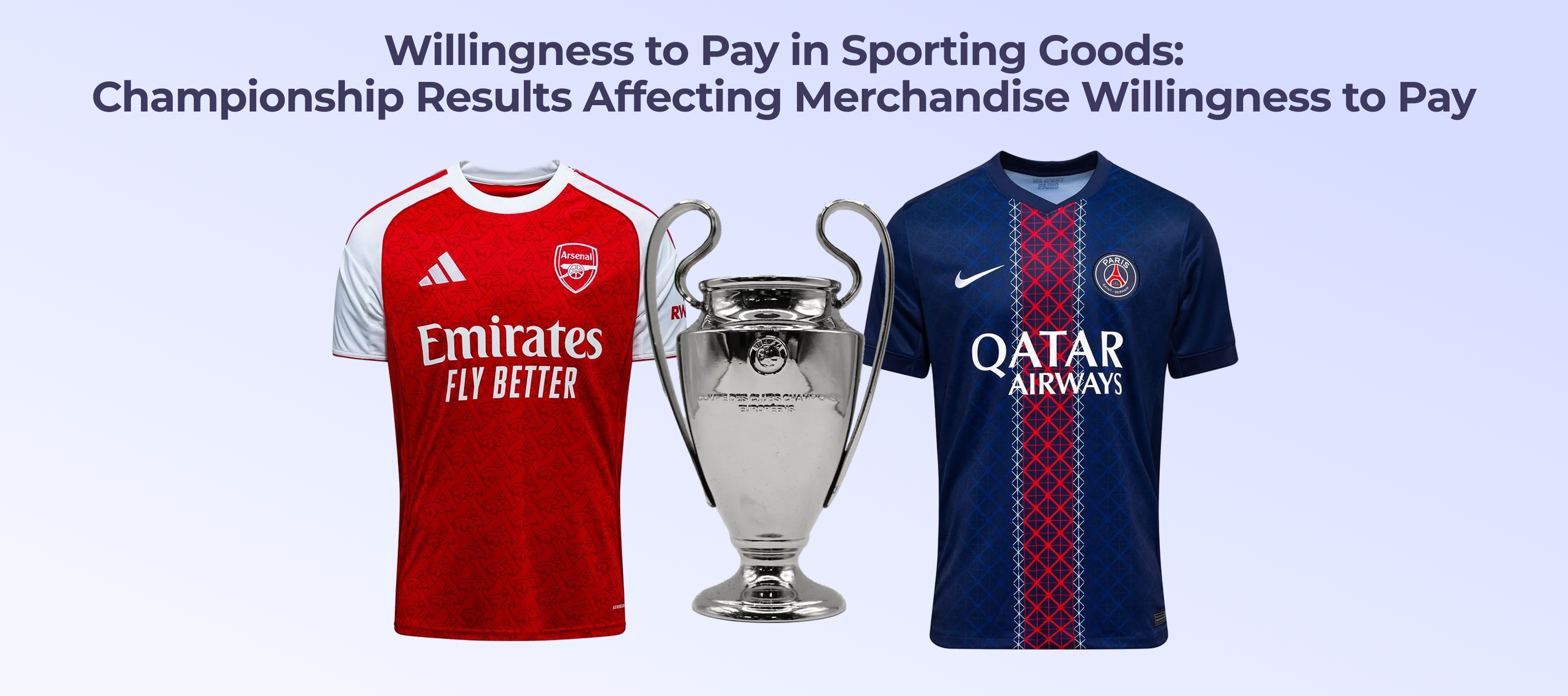
Arsenal lost the final. Their fans’ peak revenue price for finalist merchandise fell £40. PSG won. Their fans’ price barely moved. Priceagent ran the same willingness to pay study twice, before and after the result, to find out where the real pricing opportunity sits.
KEY FINDING
A loss compresses premium pricing far more than a win expands it. Arsenal fans’ revenue-maximizing willingness to pay for finalist merchandise dropped 29% after losing. PSG fans’ dropped just 7% after winning. In both cases, the strongest pricing opportunity was before the result.
The question: does a game result change what fans are willing to pay?
Sports merchandise is emotionally charged. Around a major final, fans are not only buying a product. They are buying identity, anticipation, and a stake in a historic moment. That creates a difficult pricing question for clubs, retailers, and licensors. Does the result actually change willingness to pay? And if it does, where in the price range does the shift show up?
To answer this, Priceagent ran willingness to pay studies for both finalists, Arsenal FC and Paris Saint-Germain, using the Predictive Demand Engine (PDE). Each club was studied twice: once in the week before the 2026 UEFA Champions League Final, and once immediately after the result.
WHY THIS MATTERS
Most brands assume winning creates demand and losing kills it. The data shows something more precise, and more actionable.
How the study was created
- Method. Two Priceagent Price Check studies per club, using the Predictive Demand Engine. Identical product configurations, comparable respondent profiles, same target market per club.
- Arsenal FC. London-based respondents. Before study: 12 to 18 May 2026. After study: 1 to 3 June 2026.
- Paris Saint-Germain. Paris-based respondents. Before study: 12 to 18 May 2026. After study: 1 to 3 June 2026.
- Output. Demand curve, revenue curve, and three key price points per study: max-demand price, safe-zone price, and revenue-maximizing price.
The results: what happened to willingness to pay after the final
Arsenal FC, the effect of losing
For Arsenal, the shift was significant. The revenue-maximizing price point, the price at which the Predictive Demand Engine identifies the highest revenue opportunity, fell from £139 before the final to £99 after losing. That is a drop of £40, or 29%.
Crucially, the floor of the market held firm. The max-demand price moved only slightly, from £59 to £55. The safe-zone price, the range where demand is strong and revenue is reliable, stayed at £89. Arsenal fans did not stop wanting to buy. They stopped being willing to pay a premium.
Paris Saint-Germain, the effect of winning
For PSG, the win preserved pricing power but did not appear to expand it. The revenue-maximizing price moved from €149 to €139. That is a decline of €10, or just 7%. The max-demand price held at €89. The safe-zone price remained stable at €109.
The premium was already priced in before the game. Winning protected it. Losing would have compressed it.
What this means for sports merchandise pricing
The standard assumption is that winning creates demand and losing destroys it. This data suggests a more precise picture. Losing does not eliminate purchase intent. It reduces tolerance for premium pricing. The bottom of the market stays intact. The top compresses sharply.
For Arsenal, the safe-zone price of £89 held steady despite the defeat. That means core fan demand remained strong, just not at premium price points. The revenue opportunity moved from the upper part of the demand curve to the mid-range.
For PSG, winning preserved the premium pricing ceiling, but did not raise it. The revenue-maximizing price still fell slightly after the result. The emotional premium was already present before the final, built on anticipation, not confirmation.
THE PRACTICAL IMPLICATION
The period before the final is more commercially powerful than the period after it. Anticipation is a pricing driver. The result transfers or removes it, but never adds more than was already there.
How to apply this: pricing strategy for high-stakes sporting events
This data has direct implications for anyone selling around major sporting events: clubs, retailers, licensors, and brands running promotional campaigns tied to game outcomes.
Launch premium products before the result
Willingness to pay peaks in the anticipation window, when fans are emotionally invested in the possibility of victory, not just the reality of it. That is where the strongest revenue opportunity sits. Premium products, limited editions, and high-margin bundles should be available and promoted in the days before the game.
After a loss, shift to the safe-zone price range
For Arsenal, the safe-zone price of £89 held firm even after defeat. Mid-market and accessible price points are more resilient than premium tiers after a loss. Brands should expect the revenue-maximizing price to compress, and plan their post-result offer accordingly.
After a win, protect rather than raise your prices
PSG’s win preserved pricing power, but the data does not support automatically raising prices after victory. The revenue-maximizing price still declined slightly. A winning result is a reason to maintain your premium position, not to push it further.
Measure willingness to pay before you set prices
The gap between Arsenal’s pre- and post-result revenue-maximizing price was £40. Between PSG’s, it was €10. Without measuring willingness to pay at both points, brands have no way to know which side of that gap they are on, or how far the premium ceiling will fall.
CLOSING THOUGHT
The moment before the final is more commercially powerful than the moment after it. Fans buy into the story while it is still unfolding. Once the result is known, the market changes. For the losing side, the premium story weakens sharply. For the winning side, the event premium may already have been captured before the game.