
The role of AI in modern pricing strategy
Where AI delivers in pricing and where human input still matters most.

Summarize article with AI


Updated November 2025
AI is transforming how companies set prices. It can scan thousands of competitor SKUs, predict demand surges, and optimize promotions in seconds. Tasks that once took pricing teams days or weeks. For high-volume businesses, these tools aren’t just helpful. They’re essential.
But most AI pricing models are built on what’s already happened, not what’s about to. That’s fine for optimizing the known. It leaves gaps when you’re exploring the new.
AI learns from yesterday’s sales, last year’s trends, and historical behavior. That’s powerful, until you’re launching a new product, entering a new market, or trying to understand what people would pay, not just what they did.
In this post, we explore where AI shines in pricing, where it struggles, and why the most strategic teams are combining AI speed with real-world demand signals to make smarter, faster decisions.
The rise of AI in pricing
AI is already improving pricing in meaningful ways. From streamlining promo optimization to surfacing real-time competitor data. These tools make teams faster, more responsive, and more consistent. But not every pricing question can be answered by algorithms trained on yesterday’s behavior. Some decisions require a different kind of input.

Where AI delivers real value in pricing
AI is at its best in dynamic, data-rich environments. Here are some of the most effective use cases:
- Competitive monitoring and price matching
AI tools can scan competitor prices across thousands of SKUs, updating pricing in real time to maintain parity or undercut rivals. This is common in e-commerce and marketplaces. (OECD, 2025 - Algorithmic Pricing and Competition in G7 Jurisdictions) - Demand forecasting and seasonality adjustments
AI spots demand spikes early, before holidays, campaigns, or product launches. This lets teams adjust pricing and inventory fast. Studies show AI can cut forecasting errors by up to 50% and improve margin by reducing overstock and lost sales.
(Relex, ResearchGate) - Yield and revenue management
Industries like airlines and hospitality use AI to manage seat or room availability dynamically, adjusting prices based on time-to-event, capacity, and booking behavior. Delta’s algorithms, for example, run thousands of pricing simulations per day. (The Independent, 2025) - Promotion and markdown optimization
AI can help retailers fine-tune discounts based on inventory levels and predicted demand, reducing over-discounting and lifting profit margins. One study showed a machine-learning system outperformed manual pricing by over 80% in controlled tests. (Promotheus, 2022)
These are real, proven applications. But they often rely on historical patterns and that’s where limits emerge.
Over the past decade, artificial intelligence has rapidly moved from theory to production. Transforming everything from logistics to customer service. Pricing is no exception. AI is now a key tool for many businesses seeking to automate routine decisions, react faster to market shifts, and reduce human bias.
AI-powered pricing typically draws on historical sales data, inventory levels, competitor prices, and customer behavior to dynamically adjust price points. Airline tickets, rideshare surge pricing, and large e-commerce catalogues are all common use cases.
Done well, it works. Delta Airlines, for instance, uses a dynamic pricing model built on AI and machine learning that reportedly evaluates over 100,000 variables to set fares in real time. For high-volume or commodity-based products, these models can improve margins, smooth demand, and automate complexity at scale.
The strengths of AI in pricing
Today’s AI pricing systems are strongest in environments where there is:
- A large volume of transactions (e.g. retail, travel, SaaS with self-serve tiers)
- High availability of structured data (past sales, inventory levels, competitor feeds)
- Frequent, repeated purchases that allow models to learn and iterate
- Clear signals of success, such as click-through rate or conversion rate
These systems work by learning from patterns in past behavior. If a 10% discount drove conversions last quarter, the system may recommend similar adjustments again, possibly in real time.
They’re especially useful for optimizing promotional timing, detecting competitor moves, and maximizing yield within fixed inventory constraints. For example, in a hotel booking system or seasonal fashion line, AI can help price down overstocked items before it’s too late.
What to watch: Blind spots in AI-Driven pricing

But even the most advanced models have limits. AI is powerful, but it’s not magic. Here are four areas where pricing leaders should remain cautious:
- Predictive ≠ Prescriptive
AI learns from what has happened. It cannot, on its own, recommend what should happen in a new scenario. That means:- Cold‑start scenarios
When no sales history exists, like during a product launch or market entry, the model has nothing to learn from. It guesses. There is no demand curve, only assumptions. - Shifting markets
Even when history is available, AI tends to average toward past behavior. Sudden changes in sentiment, volatility, or category value drivers can be misread or missed entirely.
- Cold‑start scenarios
- The risk of data echo chambers
If your inputs reflect past assumptions, AI will reinforce them. You risk creating a loop that optimizes yesterday’s decisions without questioning them. - Strategy is not optimization
AI can optimize towards a goal, but it can’t set the goal. Strategic questions, like whether to lead on price, build premium perception, or balance short-term revenue vs long-term brand equity, still require human judgment.
Ethics and Regulation: An Emerging Front
Algorithmic pricing comes with real-world consequences. Not just for margin, but for fairness, transparency, and accountability.
Recent academic and policy research finds that algorithmic pricing can lead to unfair price discrimination. For example by charging different prices based on consumers’ data, inferred attributes, or prior purchase behaviour. These practices can undermine perceived fairness, may lead to “price betrayal,” and are often opaque or difficult to audit at scale. (OECD, 2025)
Governments are taking notice. The EU AI Act introduces new rules for how AI interacts with consumers, classifying some pricing tools as high-risk if they affect:
- Access – limiting visibility or availability of prices to certain groups
- Discrimination – systematically varying prices based on personal data or demographic signals
- Transparency – failing to explain how algorithmic pricing decisions are made or justified

These aren’t theoretical risks. As we noted in our analysis of AI pricing in airlines, Delta’s dynamic pricing system, which adjusts fares based on thousands of variables in real time, shows the power of AI optimization, but also its blind spots. When algorithms make decisions without transparency, consumers may face price differences they can’t understand or challenge.
As AI becomes more embedded in pricing systems, ethical scrutiny will only increase. It’s not just a technical issue. It’s a governance one.
Why real demand signals beat predictive guesswork
AI can analyze past behavior, but it can’t tell you what customers will accept tomorrow. Sales data shows what was, not what could be.
That’s where real-world willingness-to-pay (WtP) comes in. Instead of inferring intent from browsing or buying patterns, WtP data captures actual demand based on customer input, right now, in the moment.
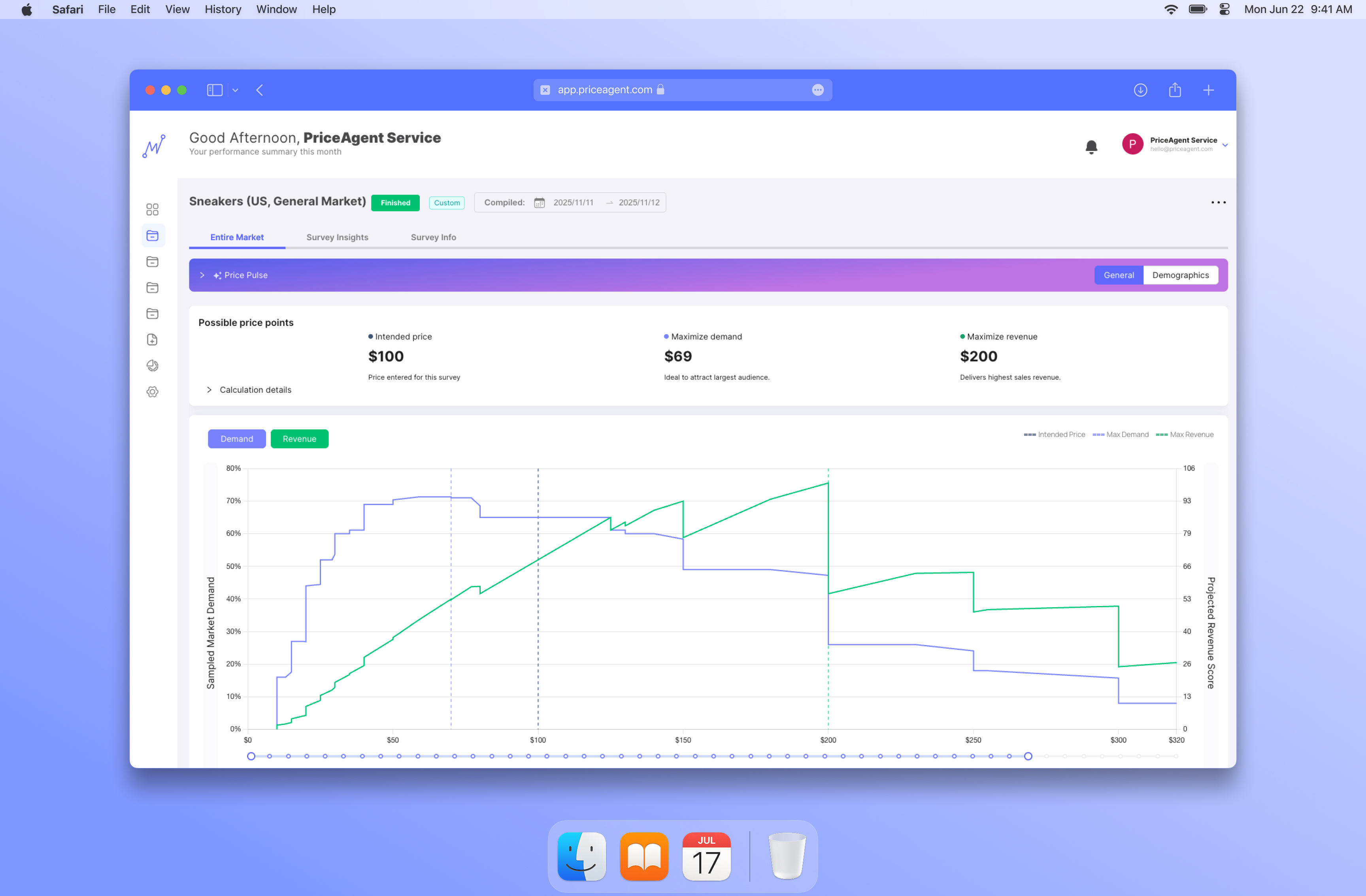
You don’t need to guess how a new price will perform. You can test it, directly. With real people. Real responses. Real tradeoffs.
This is where AI fits in: speeding up insight, not inventing it. Pricing strategy still starts with one thing AI can’t replicate, what real people value. (OECD, 2025 - Algorithmic Pricing and Competition in G7 Jurisdictions)
Conclusion
AI is changing how companies price and often, for the better. It’s fast, scalable, and constantly improving. But it’s not a crystal ball.
The most powerful pricing teams will be those who use AI to move faster, see more, and test smarter, while grounding decisions in real demand from real people. Because when it comes to pricing for tomorrow, yesterday’s data isn’t enough.